

Greetings Friends,
Two chapters to go, including this one. Now we get to my very favorite subject: food systems.
I’ve spent decades inside them, building, scaling, and trying to bend them toward something better. When I started my company in a friend’s basement, I had one clear ambition: to grow big enough to challenge what I saw as a dangerously dysfunctional food system. I wanted better versions of their products in every aisle. I used to say Farmhouse Culture was my prayer for the world.
But scale comes with tradeoffs. I lost control of the company I built and, unsurprisingly, the company itself lost its way. Sometimes I wonder what would have happened if I had stayed small. If I had chosen the path of the micropreneur instead of the unicorn founder. If I had focused on strengthening my community and leading a more balanced life instead of trying to change the world.
Admittedly, there were more hurdles then. Today, thanks to a number of factors, a hearthologist-led, home-based business is a viable, financially sound, culturally restorative career path. You may not build a fortune. But you can build a family, a community, and a life that makes sense.
Enjoy,
Kathryn
Homemade Living: Why it Makes Dollars and Sense
“All journeys bring us home at last” — Ursula K Le Guin
When Johannes Gutenberg introduced the printing press in the mid-15th century, many feared it would lead to chaos. Some claimed it would spread dangerous ideas, undermine the authority of the church and fill people’s heads with nonsense. The Catholic Church worried that mass-produced Bibles in vernacular languages would challenge their control over religious interpretation. Others feared it would destroy the “art” of handwritten manuscripts and put scribes out of work. We now know that the printing press democratized knowledge, fueled the Renaissance and enabled the Protestant Reformation. It paved the way for modern science, mass literacy and eventually democracy. Instead of leading to societal collapse, it created the foundations of the modern world.
Technological revolutions have always shaped the way people live, work and interact with the world. But the transitions are inevitably messy. From plows to printing presses to steam engines and now digital technologies, chaos becomes the norm, upending old power structures, often with overwhelming results. Dominant groups rarely relinquish control without a fight, which is always played out in politics and media.
Contrary to doomsayers, humans have proven themselves to be a remarkably resilient species, adapting not just to survive but to thrive, even through upheavals that seem insurmountable.
While I don’t claim to be an economist or a futurist, I’ve lived through multiple economic cycles, built businesses from the ground up, and witnessed firsthand where the cracks run through the systems that shape our daily lives. I know this latest technological revolution will bring unintended consequences — every major shift does. But history reminds us that upheaval also creates openings for reimagining and reinventing how we live and work.
And so, I can’t help but feel a flicker of excitement for what lies ahead. In my most hopeful moments, I envision humanity cultivating a deeper, more expansive understanding of the universe, of one another, and of ourselves. A leap in human consciousness as profound as any we’ve known.
Perhaps, too, this moment offers a rare chance to disrupt and correct some of the distortions left in industrialization’s wake, and inspire us to redefine the balance between home, work and community in ways that honor our highest calling as a species.
The Enduring Desire to Return Home
Throughout modern history, whenever society lurches too far toward mechanization, urbanization, or economic systems that disconnect us from our natural rhythms, a countercurrent emerges, a longing to return home, to the land, to something slower and more human-paced. It’s as if the more technology accelerates, the more we yearn for something steady and real. Sound familiar?
In college I was fascinated with the Transcendentalists of the 19th century, the early pioneers of the retreat-from-modernity impulse. Ralph Waldo Emerson preached self-reliance and Henry David Thoreau took it a step further, withdrawing to Walden Pond to build an off grid cabin, grow his own food and contemplate life on his terms. But here’s the thing: Thoreau’s retreat was not entirely self-sufficient. He relied on his mother to do his laundry while Emerson, the great champion of independence, was subsidizing Thoreau’s experiment. In other words, even the fathers of self-reliance weren’t actually self-reliant. As mothers have known since the beginning of time, philosophy alone doesn’t put food on the table.
Fast-forward a century, and the 1960s-70s counterculture revived the same impulse. Fed up with war, capitalism and consumer culture, thousands of young people fled cities to form rural communes, imagining a life of agrarian simplicity. They envisioned utopian communities where they could grow their own food, live cooperatively and escape the constraints of modern industrial economies. Some succeeded — most failed. They learned hard lessons like farming is a lot tougher than it looks (a few tomato plants doth not a self-sufficient farm make.) Then they ran into the problem of needing cash for things they couldn’t produce (medicine, tools, property taxes). And finally, the work of maintaining a community, like decision-making, resource distribution and power dynamics, was often these communities’ undoing.
The Israeli kibbutzim were among the few large-scale communal living experiments that actually worked for a time. Rather than opting out of the market economy, they engaged with it directly, producing agricultural goods and later industrial products for export. Income was pooled and redistributed collectively, allowing the community to provide housing, childcare, education, and healthcare to all members.
But even they couldn’t remain insulated from economic pressures. As global markets expanded and their goods became less competitive, many struggled to sustain the collective financial model. By the late 20th century, faced with mounting debts and changing cultural tides, a significant number moved toward privatization, loosening the communal structures that had once defined them. At the same time, younger generations were increasingly drawn to careers and lifestyles in urban centers, leaving fewer willing to carry the original vision forward.
As inspiring as these movements were, they all ran headfirst into economic reality. Without a way to generate sustainable income, many were forced to return to the very structures they sought to escape. Some communities collapsed under the weight of their own centralization; others simply dissolved as their children left in search of different lifestyles. In the end, they all shared the same Achilles’ heel: a failure to build an economic foundation strong enough to endure.
Still, the desire persists for a way of life that integrates home, work and community in a meaningful way. The question, then, is how we can do so in a way that provides economic resiliency, is socially sustainable, and is adaptable to modern realities.
The Price of Staying Small
When the Buy Local movement gained momentum in the early 2000s, I was thrilled. Involved in the local food scene, I was already buying many of my goods locally and hoped that with a little marketing push, many more would. The quality of the food was without exception, cleaner, fresher and better tasting —but it came at a significant cost. Handwoven wool sweaters, hand shaped candles and locally fired ceramics are amazing but I recognized then that many of my neighbors could not afford the steep prices of artisan goods. Last week, I paid $11 for a loaf of bread from my favorite local bakery, about double what a commercial bakery charges. Despite these high prices, the makers aren’t getting rich. So what’s going on?
For small local producers, economies of scale are a constant uphill battle. They face the same regulatory requirements and labor costs as large companies do, plus they pay significantly more for raw ingredients and a higher premium to distributors. While researching jars for some of my first sauerkraut batches to be sold at a farmers’ market, I learned that the minimum order was 5,000. I only needed 500, which meant that I paid near retail prices for every single jar. To stay afloat, I had no choice but to pass the cost on.
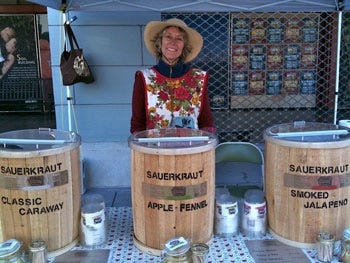
I remember speaking at an event on local food systems years ago when one of my co-panelists, a rancher, shared his struggle trying to sell $10 lamb chops at farmers’ markets, which was the cost of a meal for a family of four at McDonald’s back then. He wasn’t alone. Across the industry, I saw well-intentioned farmers, artisans and small-scale food producers trying to do the right thing but facing insurmountable challenges. The odds were stacked against him and, sure enough, the ranch was out of business within a year. I managed to hold on, scaling the business and finally seeing margins shift in our favor. But then a new problem emerged.
When you hit on a popular concept and create a high-quality product, the big players take notice. Small food producers often find themselves with two choices: sell to a large company before they figure out how to make your product cheaper and out compete you or take on venture capital to scale fast enough to stand a chance. I chose the latter, but in doing so, I lost controlling interest in my company and was eventually pushed out. My story is unfortunately not unique; it’s one that reveals just how difficult it is to build something lasting without being absorbed into the very system you set out to improve.
The High Cost of Connection
Still involved in the food business, I kept a close eye on the “sharing economy,” where innovators were turning their attention toward monetizing home and care. By 2016, Uber and Airbnb had already transformed transportation and hospitality and now platforms like Care.com were doing the same for caregiving by connecting families with caregivers while skimming a cut from every transaction.
Then Shef.com came along in 2019, promising to bring homemade meals to consumers. At first glance, it seemed like a win for home cooks, for eaters and for the vision of a more personal, human-scale food system. But the closer I looked, the more disillusioned I became. Although I imagine each meal is lovingly prepared in someone’s home kitchen, that intimacy disappears the moment it enters their system. The food is whisked away by an anonymous driver to a centralized facility, chilled, packed into a single-use cooler bag, and handed off to a delivery network that treats it like any other takeout order. No stories, no connection — just another transaction, wrapped in absurd amounts of unsustainable packaging, destined for the landfill, and cloaked in the comforting language of “homemade.”
To be fair, platforms like Shef.com do provide some support to home cooks; they offer a way to legally sell food, access customers and generate extra income. But can anyone truly make a living this way? The math says no. By the time the platform takes its cut, and after factoring in cost of goods and overhead, cooks would be left with meager profits at best. The real winners in these types of models are the companies and shareholders who’ve figured out how to monetize the comfort and nourishment of the hearth without actually strengthening it.
Although I saw and still see the value in what these innovative companies do, it’s hard to ignore how huge some like Care.com have become, operating in over 20 countries, with thousands of employees. I just can’t shake the feeling that something is off. Should big corporations and shareholders really be extracting profit from the already modest earnings of the people actually doing the work — just for the privilege of connecting with their neighbors?
As it turns out, more equitable alternatives were already underway in my own community. In 2012, California took a groundbreaking step by legalizing cottage food businesses, allowing a wide variety of homemade foods to be prepared at home and sold directly to the public. I was a passionate advocate for this legislation, even voicing my support publicly, but I hadn’t yet connected the bigger picture dots. Having started my own business under the regulatory radar in my neighbor’s basement, I saw this new law as a practical stepping stone, a way for small businesses to test their ideas before taking on the typical costs of starting a business in the public sphere. To me, it was a bridge to traditional entrepreneurship, not yet a vision of something bigger.
In 2018, the state went even further with Microenterprise Home Kitchen Operations (MEHKOs) legislation, enabling home cooks to run small-scale restaurants from their own kitchens — think neighborhood pop-ups serving fresh tacos or hearty BBQ, either for takeout or in-home dining. This was revelatory for me as I thought back to all of the home restaurants I had encountered in my travels.
In Mexico, where I lived for a time, I ate lunch regularly at a home where a mother daughter duo cooked and served meals at a communal table. While children ran underfoot, friendships were formed over plates of delicious homemade foods. It was a thriving business, but it didn’t feel like one. It felt like home — because it was. In Peru, I spent time in Quechua villages, where women carried on centuries-old culinary traditions, cooking and selling food right from their homes. Their knowledge, passed down through generations, gave them both economic independence and a respected place in their communities.
These women were not trying to build utopias or escape modern life. They were simply making a living, at home, in a way that kept them connected to their families, their communities and their traditions. The most resilient economic model I had been searching for was already woven into the fabric of daily life in cultures around the world.
The problem isn’t that home-based economies can’t work but that we stopped making space for them to thrive. Of course, it makes sense to produce some goods at scale but just as many are better when made by hand, in small batches, in home kitchens. We can all taste and feel the difference between mass-produced and homemade goods and services. As E.F. Schumacher reminded us in Small Is Beautiful, not everything scales well. Some things are best when kept close to the hearth.
In cultures around the world, the cottage business model is alive and well. Even here in the United States, informal childcare, school networks and food makers (like our local tamale lady) never disappeared entirely. They simply went underground, not out of dishonesty, but out of necessity, unrecognized by formal economic and regulatory structures. It’s time to bring them out of the shadows and acknowledge them for what they truly are: hard working people trying to carve out a living in a system that hasn’t made room for them.
Hearth as Habitat and Hub
COVID arrived before counties in California could establish the infrastructure to regulate MEHKOs, but something else took shape in its place. As lockdowns rippled through communities, people instinctively formed small ‘safe zone’ groups, cooking together, sharing meals, and rediscovering the deeply human joy of conviviality. The warmth of being nourished in good company, where food, laughter, and presence were shared freely, was a revelation for many.
As supply chains faltered, many of us returned to the basics, making from scratch what we once bought, including staples like bread, preserves and ferments. Suddenly, sourdough was everywhere, with people scrambling to get their hands on a starter. But it wasn’t just bread. Fermentation, in all its forms, was having a moment. Even though our 2019 book tour was cut short, The Farmhouse Guide to Fermentation was flying off the shelves.
Working from home became much more than a temporary solution; it was an awakening. Home was no longer just a layover between the rush of daily life, it was a refuge, a creative space, a place where mornings stretched gently into the day and where work could coexist with the rhythms of real life. It became something worth tending to, shaping with care, making it beautiful, not just a place to sleep, but a place to be.
As COVID continued, demand for home upgrades surged, stripping shelves of garden supplies, lumber, kitchen cabinets and appliances. Backorders stretched for months, as people rushed to reimagine their living spaces as places of comfort and nourishment. I remember this so clearly because while we waited almost a year for our new kitchen to arrive to our just-completed house. In the interim I cooked every meal on a camp stove and an electric frying pan perched on a single tiny counter.
While people rekindled their relationships with home, something else was stirring — a dormant entrepreneurial spirit. One couple I met went all in, ripping out their front and back lawns and transforming them into thriving vegetable gardens, not just to feed themselves, but to share and sell their bounty with neighbors. When lockdowns were lifted, she returned to work while he stayed home with the kids. Apparently, his sales were upwards of $40K, and I imagine that number has since gone up, because last I heard he’d added beekeeping and backyard chickens to the mix. Lucky neighbors! Today, I see micro-bakeries popping up almost daily, like a local mom who recently left the grind of her public sphere catering company to bake from home for all of us. I can hardly wait to taste her goods.
There’s no shortage of interest in homemade goods and services. I’ve asked countless friends and strangers if they would be interested in an app they could use to see who’s serving lunch in their neighborhood, who has fresh eggs, just-picked produce or a loaf of sourdough still warm from the oven. Who’s selling honey, handmade candles or small-batch beauty products, all for a fair price. Every time, the response is the same: enthusiastic nods and ‘yes!’
Maybe this feels so right because it’s in our DNA. We’ve always done business with our neighbors. Sharing, selling, bartering is how we built communities, how we made use of what we had, how we ensured nothing went to waste. In fact, for most of human history we were all entrepreneurs. We hunted, gathered and farmed, not for a paycheck but for sustenance. We shaped tools, wove cloth, fermented, baked and traded as a way of life. The marketplace wasn’t some distant entity, it was right in our homes, woven into the fabric of daily life. Work and home were entwined, stitched together by purpose, skill and the kind of knowledge that cultivated both self-sufficiency and interdependence.
While the pandemic brought undeniable hardship and loss, the blurring of lines between home and work revealed a way of life that, for some, felt freer, more humane, and far too fulfilling to abandon.
Families were forced to make impossible choices when schools and daycare centers shut down, and in most cases, it was women who stepped away from the workforce to care for children at home. Many responded with the grit and ingenuity that has always held families and communities together. They adapted and reimagined daily life as best they could.
But amid the disruption, something unexpected surfaced. For many parents, the math suddenly made sense. Without daycare costs, commuting expenses, (and the relentless juggle), they found they could get by on one income. Stimulus checks helped, certainly, but beyond finances, something deeper clicked for these moms. The work of being home with their children, hard as it was at times, was also profoundly meaningful.
By 2021, that awakening had become a movement. The Great Resignation saw 47 million Americans walk away from their jobs. Most were women, who made up 77% of the care-driven sectors hit the hardest — hospitality and healthcare.
After chasing the elusive ideal of “having it all” for so long, many mothers began to see the cracks in that promise. For the first time in years, maybe ever, they found they could be fully present. Mornings weren’t frantic battlegrounds of shoes, toast, and car seats. There was space for the simple pleasures of unhurried breakfasts and backyard adventures, for slow afternoons spent building forts, or reading aloud without checking the clock. The joy of simply spending time together felt less like a luxury and more like a long-forgotten birthright. For many, there was simply no going back.
The pandemic had forced another reckoning as millions stepped away from their jobs, it became clear that the way we work and live was already shifting beneath us. The rise of the gig economy, the sharing economy, cottage businesses and decentralized platforms was suddenly accelerated. And while these may feel like new inventions, they are, in many ways, a return to something ancient and more familiar than we realize.
The boundaries between work and home, public and private, employer and employee, are softening. We are coming full circle, relearning how to work for ourselves rather than simply for wages.
Counting What Counts
I didn’t believe my first spreadsheet. My initial profit-and-loss model for home-based restaurants suggested that serving or selling just 30 reasonably priced meals, three times a week, could net around $45K annually, with profit margins nearing 50%, a stark contrast to the razor-thin 4-6% typical of traditional restaurants. But the real surprise? The numbers held up across nearly every home-based business I analyzed.
I started comparing wages across various professions in the traditional market economy versus their home-based alternatives. The pattern was clear: in almost every case, working from home was just as profitable, if not more so. Cooks, bakers, childcare providers, teachers and tutors, seamstresses, micro farmers, all could earn as much, if not more, from home while working fewer hours, on their own schedule.
And it makes sense. The internet has leveled the playing field and bulk pricing isn’t just for big businesses anymore. Today anyone can order raw materials from a number of distributors like Amazon or Azure Standard. Farmers markets, now ubiquitous, made buying directly local farmers a reality for everyone. Without high rent on commercial spaces, expensive middlemen and massive retail markups, home-based businesses can offer high-quality goods and services at prices that actually work for working families.
Digital marketplaces and payment platforms have made it easier than ever to buy and sell directly from each other. Social media groups, neighborhood apps and online communities help us connect with the people living right next door. The same AI-driven matching systems that power ride-sharing and gig work could be reoriented, not just to link consumers with corporations, but to connect neighbors with each other.
Beyond flexibility and independence, the financial upside of a home-based business is substantial, especially when it comes to taxes. Employees are often taxed at the highest rates, often upwards of 35%. But as a small business owner, that burden can often be cut in half, thanks to a wide range of deductions: home office space, utilities, equipment, even food costs for testing new recipes. Everyday expenses like phone and internet service, business-related travel, and professional development can also be written off. Retirement contributions can be strategically structured to lower taxable income, often with higher limits and more flexibility than traditional employee plans.
Shannon Hayes, author of the super smart and often hilarious book “Redefining Rich,” breaks income into four categories: meaningful employment, business income, non-monetary income and passive income — a framework that makes so much sense.
She points out that when one member of the family holds a steady job with benefits like health insurance, it pairs beautifully with the tax advantages and flexibility of a home-based business. Non-monetary income, often overlooked, is just as valuable. Hayes defines it as “any need that can be met without having to shell dollars out for it.” Skipping daycare costs? That’s a win. Buying products for your family at wholesale prices? Another major perk.
Then there’s passive income — 401(k)s, IRAs, rental properties, and other revenue streams — can all provide long-term financial security. While it can be hard to save for the future when total household income is modest, every dollar counts. That’s where the real beauty of a home-based life begins to shine. If one person is home full-time, expenses can often be trimmed significantly. Cooking from scratch, tackling DIY projects, and finding creative ways to meet needs without defaulting to the marketplace are just some examples.
If you’re thinking about starting a home-based business, I highly recommend Haye’s book. In a time when the meaning of work and wealth is up for revision, Redefining Rich is a field guide for crafting a life that works on your terms.
When Space is Tight
But what about those who live in apartments or don’t own homes? Nancy Chang in Berkeley, California didn’t let her small apartment stop her. During the pandemic, she launched a healthy soup company called Purpose and Hope. While you can’t sit in her living room or garden, you can pick it up at her place or request a delivery. From what I hear her business is so popular she will very likely expand to a small commercial kitchen. In fact, most businesses that you run from home translate nicely to expansion into larger versions if that’s your eventual goal.
Commissary kitchens offer another path for home-based businesses. Fully outfitted commercial kitchens can be rented by the hour, giving food entrepreneurs a way to batch-produce cottage foods or meals for their communities without the crushing overhead of leasing their own facility.
I know this model well. When I first launched my food business, I couldn’t really afford my new commercial kitchen, so I had to get creative. Renting out the space when we weren’t using it, and charging by the hour to local food makers turned out to be a win-win. Two of my first tenants were moms, both trying to turn their love of cooking into a livelihood.
We operated the commissary kitchen until our business outgrew the arrangement and we needed the space full-time. These types of kitchens are available all through our region and more are emerging across the country. If your community doesn’t have one yet, consider starting one. Our kitchen was modest but we still made it work. You don’t need a fully outfitted commercial kitchen to begin — just the basics and a bit of ingenuity.
I can easily imagine a childcare exchange woven into the mix, one parent watches the kids while another works for a few hours, then they swap. It’s not a perfect solution, but it’s a practical starting point, one that could make it easier to build momentum until producing from home becomes a viable option.
Homecoming
While I’m certainly not suggesting we all quit our jobs to become micropreneurs or hearthologists, for those of us who love the hearth arts, it’s an incredibly appealing option. And why shouldn’t we bring as much of our work home as possible? With AI projected to disrupt more than 50% of jobs in service, retail and manufacturing over the next decade, one thing is certain, we’re going to have to think and act imaginatively.
Rather than resisting these upheavals, we have an opportunity to turn them to our advantage and to reshape our lives in ways that optimize human flourishing. Yes, it might mean our sleepy suburban neighborhoods start to feel more like bustling villages, but would that really be such a bad thing?
While communities built around care and connection may not fill the God-sized hole left in the market’s wake, they can begin to re-thread the sacred into daily life. The hearth becomes an altar. A meal, a type of communion. The walk to a neighbor’s door takes on the shape of a pilgrimage. In tending to the child, the elder, the stranger, we return to the shared rituals that have long shaped religious traditions and spiritual life across time and cultures. What if the values that once formed the foundation of temples and villages shaped our neighborhoods again?
Imagine a world where every third house is a home-based business: a daycare, a massage therapist, a nurse practitioner, a dog sitter, a bakery, a community garden, and a micro-restaurant where the chef knows your name. A lively neighborhood where parents swing by a hearthologist’s home on his/her way back from work, scoops up the kids and the family dog, trades a few words at the door before heading home with four homemade dinners and a fresh loaf of bread. In this scenario, hearthologists become the stewards of a resilient, home-based economy where care is redistributed at the local level.
Communities will have to decide for themselves what they value most, but I know this is the world my son and I needed in 1985, when I became a single mom. If such a neighborhood economy had existed, I could have stayed home to earn a living and raise my son with the presence and care he deserved.
To bring work home is an evolution toward lives that make sense, where our labor aligns with the rhythms of real life rather than contorting around the demands of the market. Reclaiming the hearth in this way allows us to experience home as both workshop and wellspring, a cultivated web of care capable of nourishing us all.
AI may be the most profound technology humanity has ever encountered, and it remains unclear whether it will serve as our great liberator or hasten our unraveling. Throughout history, when technological shifts reconfigured our institutions, it was the informal, relational labor rooted in the hearth that sustained the continuity of civilizations.
Given this enduring presence in our lives, I have come to believe the most important question of our time is this: How do we build a future that prioritizes the care and connection the hearth embodies? How do we design new systems that ensure we flourish and endure as a species?